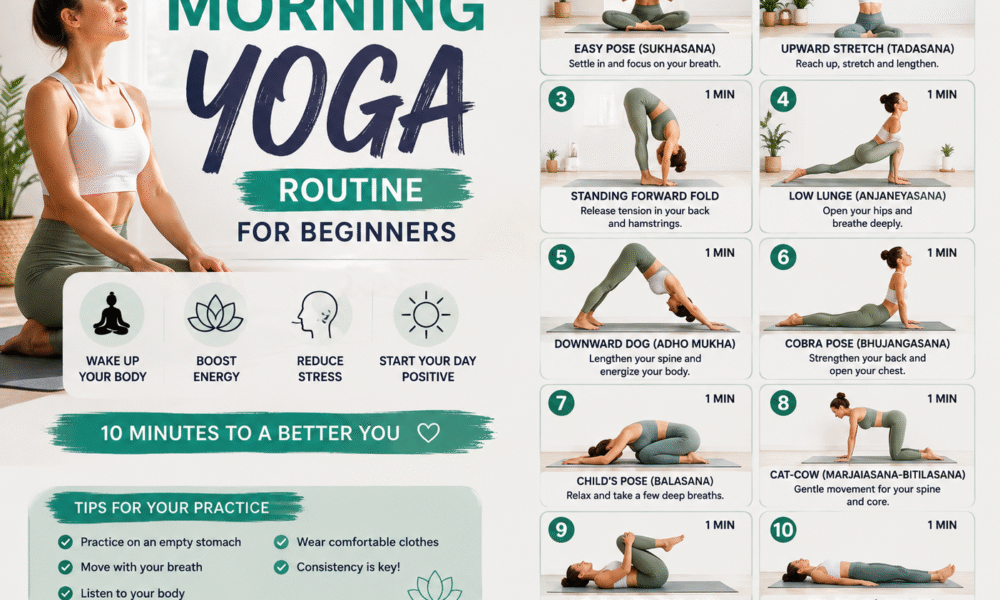
Ten minutes is a genuinely realistic amount of time to find every morning, and it’s enough to make a real difference to how the rest of the day feels. This sequence needs no experience, no equipment beyond a mat, and works whether you’re stiff from sleep or just want a calmer start than scrolling your phone in bed.
Why Morning Specifically?
Practising before the day’s demands start means there’s no competing with a full inbox or a tired evening brain. It also tends to stick better as a habit — mornings are more routine and less likely to get cancelled by an unpredictable evening. That said, if mornings genuinely don’t work for your schedule, this same sequence works just as well at any time of day.
The 10-Minute Sequence
- 1 minute — Seated breathing. Sit comfortably, eyes closed, and simply notice your breath for a minute before moving. This settles the nervous system before you start.
- 2 minutes — Cat-Cow. On hands and knees, slowly alternate arching and rounding the spine with your breath. Excellent for waking up a stiff back after sleep.
- 2 minutes — Downward Dog to Forward Fold. Move slowly between the two, pedalling the feet to ease tight hamstrings and calves.
- 2 minutes — Low Lunge, both sides. Opens the hips, which tend to be tight first thing in the morning for most people.
- 2 minutes — Seated twist, both sides. Gentle spinal rotation to finish, which many people find genuinely energising.
- 1 minute — Standing or seated, a few deep breaths before starting the day.
If you’re brand new to any of these poses, our complete beginner’s guide to home yoga explains the basics in more depth, including what a wider weekly structure around a routine like this can look like.
Making It a Habit That Actually Sticks
The single biggest factor in whether a morning routine survives past week one is friction — if your mat is rolled up in a cupboard, it’s one more excuse. Leaving it unrolled somewhere visible the night before removes that barrier almost entirely. It’s also worth accepting that some mornings will only get you through half the sequence, and that’s still worth doing rather than skipping entirely.
When Mornings Feel Too Rushed
If ten minutes genuinely isn’t available some days, the breathing and Cat-Cow alone (roughly 3 minutes) still deliver a meaningful chunk of the benefit. And if mornings consistently feel like the wrong time, a calming evening sequence — like the one in our guide to yoga for stress and anxiety — might suit your schedule better without losing the habit altogether.
Adapting the Routine to Your Body and Schedule
Ten minutes is a floor, not a ceiling. On a morning when you have twenty, the simplest expansion is to repeat the standing sequence on both sides a second time rather than adding unfamiliar poses — repetition is where the movement patterns actually settle in. On a genuinely rushed morning, three rounds of Cat-Cow and a single Downward Dog held for five breaths is still a worthwhile practice and keeps the habit intact.
Bodies are also stiffest first thing, when spinal discs are at their most hydrated. That’s a good reason to be conservative with forward folds and deep twists in the first few minutes, and to keep knees generously bent in any standing fold. If you have a history of lower-back trouble, warm up with Cat-Cow and gentle standing movement before anything that loads the spine in flexion.
Frequently Asked Questions
Should I practise before or after breakfast?
Before, ideally, or at least an hour after eating. Twists and forward folds are uncomfortable on a full stomach.
Is ten minutes really enough to be worthwhile?
Yes, if it’s regular. A daily ten minutes produces more change over a month than a single long weekend session.
Do I need a mat for a short morning routine?
For standing work you can manage without one, but any kneeling or floor poses on a hard floor will be uncomfortable and less stable.