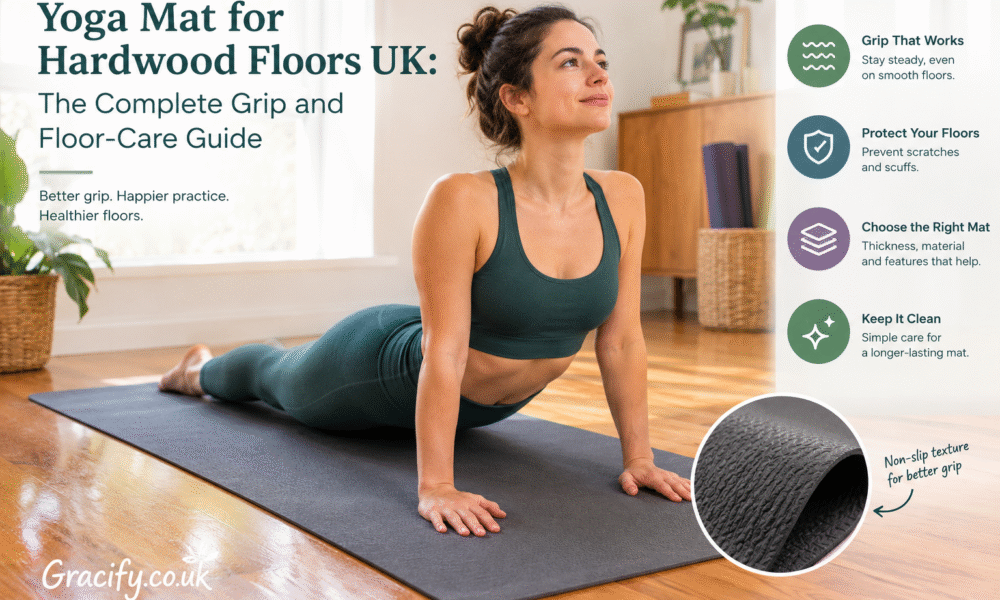
If you’ve ever launched into downward dog on a freshly polished hardwood floor and felt your mat skate away beneath your hands, you already know that “yoga mat” and “yoga mat for hard floors” are not quite the same product. Practising on carpet is forgiving. Practising on hardwood, laminate, engineered wood or tile is a different physical problem entirely, and most advice written about it comes from the US, where solid hardwood is the default domestic floor. In the UK, it isn’t. Laminate and engineered wood dominate British living rooms, hallways and home-gym conversions, and they behave differently underfoot to true hardwood — something almost no existing guide bothers to explain.
This guide is written specifically for UK homes and UK flooring. It covers why mats slide on hard floors in the first place, how hardwood, laminate, engineered wood and tile each demand a slightly different approach, what actually stops a mat moving (as opposed to what sounds like it should), and how to protect your floor from the marks and residue a mat can leave behind over months of use. It isn’t a top-ten shopping list. It’s the background you need so that whatever mat you choose — or already own — actually stays put.
Why Yoga Mats Slide on Hard Floors: The Physics in Plain English
Grip during a yoga practice happens in two places at once: between your skin and the mat’s top surface, and between the mat’s underside and the floor. On carpet, that second junction barely matters — carpet fibres grab almost anything. On a hard, smooth, sealed surface, it’s the whole game, and it comes down to friction.
Friction depends on two things: the roughness of the two surfaces in contact, and how much they’re pressed together (which is mostly your body weight transferring through your hands and feet). A polished hardwood floor, a laminate floor, and a glazed tile floor are all, at a microscopic level, extremely smooth. Smooth-on-smooth contact produces low friction — there’s nothing for the mat’s underside to physically key into, so it relies on other mechanisms to stay in place.
There are really three mechanisms at work, and different mat backings lean on different ones:
- Adhesive/tacky friction — some rubber compounds are naturally sticky, almost like a very mild suction, because the material itself has high surface tension against a smooth substrate. This is why natural rubber and some PVC mats feel “grippy” straight out of the box on a hard floor, even when perfectly dry.
- Mechanical/textured grip — a raised or dimpled underside pattern increases the surface area in contact with the floor and resists lateral sliding the way tyre tread resists skidding, even on a compound that isn’t especially tacky.
-
Mass, Pressure and Surface Contamination
Mass and pressure — a heavier, denser mat simply resists being pushed sideways more than a light one, purely through inertia and the weight of material bearing down on the floor.
This is why a 3.5kg natural rubber mat often outperforms a 900g travel mat on the same hardwood floor, independent of the compound used.
Most mats marketed generically as “non-slip” are really only solving the skin-to-mat side of the equation with a textured top layer. That does nothing for a mat that skates across a laminate floor because the underside is smooth EVA foam with no mechanical grip and not enough mass to stay anchored. If your mat slides specifically at the base, not just under your hands, the problem is almost always the underside material and weight, not the top texture — and that distinction is the one most buying guides skip past.
Two everyday factors amplify the problem regardless of mat quality: fine dust and floor-care products. Hard floors accumulate a thin layer of dust and skin particles that acts almost like ball bearings between mat and floor, letting the mat glide even when the backing material itself has decent grip. And many laminate and hardwood cleaning products leave a faint polish or silicone residue designed specifically to make the floor smoother and shinier — which is exactly what you don’t want underneath a yoga mat.
If your mat has started sliding more than it used to, check when the floor was last mopped with a polish-based cleaner before you blame the mat.
Hardwood vs Laminate vs Engineered Wood vs Tile: Why UK Floors Aren’t All the Same
This is the section most hardwood-focused guides skip entirely, and it matters more in the UK than almost anywhere else, because true solid hardwood is relatively rare in British homes compared with laminate and engineered wood.
Solid hardwood is real timber, sanded and finished with either an oil or a polyurethane lacquer. Oiled floors have a slightly more open, matte surface and offer marginally more natural grip than lacquered ones, which are sealed to a glassy, low-friction finish. If you have solid hardwood, check which finish it has — an oiled floor is more forgiving of an average mat than a heavily lacquered one.
Laminate and Engineered Wood Floors
Laminate is a printed decorative layer bonded over fibreboard, topped with a hard-wearing resin coating. It’s the most common hard-floor surface in UK homes, and that resin top layer is engineered to be scratch-resistant and easy to wipe clean — properties that also make it one of the most slippery surfaces a yoga mat will ever sit on. Laminate has essentially zero texture at a microscopic level, so mats that rely on mechanical grip (raised patterns) tend to underperform here compared with tacky rubber compounds that create adhesion through surface tension rather than texture.
Engineered wood is a thin veneer of real timber over a plywood or high-density fibreboard core, usually finished similarly to solid hardwood (oil or lacquer). Grip behaviour is close to solid hardwood with the same finish — it’s really the surface coating, not the substrate underneath, that determines how a mat behaves.
Tile (ceramic, porcelain, or natural stone) varies enormously by finish. Matte or textured tiles offer decent natural grip; polished or glazed tiles are among the most slippery surfaces you can practise on, rivalling wet laminate. Underfloor heating, common with tiled kitchen-diners in newer UK homes, adds a further wrinkle: warmth can soften some rubber and PVC compounds slightly, occasionally improving tack, though it can also accelerate degradation of cheaper foam backings over time.
Floor Type Comparison at a Glance
| Floor type | Typical UK prevalence | Natural grip level | Best-suited backing | Notes |
|---|---|---|---|---|
| Solid hardwood (oiled) | Lower — period homes, high-end renovations | Moderate | Natural rubber, tacky PVC | More forgiving than lacquered finishes |
| Solid hardwood (lacquered) | Lower | Low | Natural rubber, textured TPE | Glassy finish; avoid smooth-backed foam mats |
| Engineered wood | High — very common in new-build and renovated homes | Low–moderate | Natural rubber, tacky PVC | Behaves like its surface finish, not its core |
| Laminate | Very high — most common UK hard floor | Low | Natural rubber (tacky, not textured) | Resin coating resists mechanical grip patterns |
| Tile (matte/textured) | Moderate — kitchens, bathrooms, conservatories | Moderate | Most backings work reasonably | Grout lines can add minor texture |
| Tile (polished/glazed) | Moderate | Very low | Heavy natural rubber, suction-style backing | Worst-case scenario; combine with a rug or towel underneath |
The practical takeaway: if someone tells you “just buy a rubber mat,” they’re giving you advice that’s roughly right for hardwood but potentially wrong for laminate, where a tacky compound without heavy surface texture usually outperforms a mat marketed purely on its textured “non-slip” pattern.
Mat Backing Materials and How They Actually Perform on Hard Floors
We’ve covered material choice broadly in our natural rubber vs cork and TPE vs EVA vs PVC guides — this section is specifically about hard-floor grip performance, not a general buying guide.
| Backing material | Grip mechanism | Hard-floor performance | Trade-off |
|---|---|---|---|
| Natural rubber (open-cell) | Tacky compound + moderate mass | Excellent on hardwood, laminate, and tile | Distinctive rubber smell when new; not vegan-strict for some buyers’ preferences around latex sensitivity |
| Natural rubber (closed-cell) | Tacky compound, less absorbent | Very good, slightly less than open-cell | Marginally less grippy than open-cell but easier to wipe clean |
| PVC (tacky formulations) | Adhesive surface tension | Good to very good on smooth floors | Durability varies hugely by manufacturing quality; cheap PVC degrades to a slick, glazed surface within months |
| TPE (textured) | Mechanical texture, low mass | Fair on hardwood and tile; weak on laminate | Very light, which works against it on hard floors — texture alone can’t compensate for low mass |
| Cork-topped, rubber-backed | Rubber underside handles the floor contact | Performance matches the rubber backing, not the cork face | Cork is a top-surface material for sweat grip — the backing underneath is what interacts with your floor |
| Jute-blend | Natural fibre texture | Poor to fair; best on textured tile, weak on laminate | Adds an eco-friendly feel but rarely the best choice for a slippery floor specifically |
| Standard closed-cell foam (budget mats) | None specifically designed for grip | Poor across all hard floors | The most common cause of “my new mat keeps sliding” complaints |
A quick way to sanity-check a mat before buying: press your thumb firmly into the underside material and drag it sideways across a smooth worktop or hard-floor sample. A mat that resists that drag under light thumb pressure will behave dramatically better under full bodyweight than one that slides freely.
Thickness vs Grip on Hard Floors: A Trade-off Nobody Explains Properly
Thickness and grip are often discussed as if they’re the same conversation, but on a hard floor they pull in different directions, and that tension deserves its own explanation rather than a single throwaway line in a buying guide.
A thicker mat cushions your knees, wrists and spine more generously — genuinely useful on an unforgiving hard floor where there’s no carpet pile to soften impact. But added thickness, especially in softer foams, can also reduce stability: the more give a mat has, the more your body weight compresses and shifts within the material itself during a pose, which can feel like sliding even when the underside isn’t actually moving against the floor. This is especially noticeable in standing balance poses like tree pose or half-moon, where a very plush, thick mat on hardwood can feel unexpectedly wobbly.
The practical resolution isn’t “thinner is always more stable” — it’s that density matters more than thickness alone. A dense, higher-quality rubber mat at 4–5mm will typically feel more stable on hardwood than a soft, low-density foam mat at 8mm, because the denser material compresses less and transmits your weight more directly down to the grippy underside layer. If your knees need more cushioning than a dense mat provides, a separate folded towel or thin foam knee pad under specific poses solves that without sacrificing the base mat’s stability — a much better fix than simply buying the thickest mat available and hoping it holds still.
Protecting Your Floor: Marks, Residue and Long-Term Care
This is arguably the most neglected topic in existing content on this subject, and it matters enormously for renters and anyone with newly laid laminate or engineered wood.
Discolouration and “yellowing” marks. Some PVC and rubber mats, particularly cheaper ones, can leave a faint discoloured patch on light-coloured laminate or varnished wood if left in exactly the same spot for extended periods, especially in a room that gets direct sunlight. This is usually a plasticiser migration effect — chemicals in the mat’s compound slowly transfer to the floor’s surface finish. It’s more common with budget PVC than with natural rubber, and more common on floors with a softer or older lacquer finish. If you always practise in the same spot, occasionally rotating the mat’s position, or lifting and airing it between sessions rather than leaving it permanently unrolled, meaningfully reduces the risk.
Marks, Residue and Scratches
Rubber residue and “ghosting.” Natural rubber mats, particularly new ones, can transfer a faint dusty residue onto very smooth, dark, or matte-finished floors during the first few weeks of use, before the surface has fully cured and settled. Wiping the mat’s underside with a barely damp cloth before first use, and giving a new mat a few days of open-air time before its first session, reduces this considerably.
Scratches from grit. The real risk to a hard floor isn’t the mat itself — it’s whatever grit or dust gets trapped between the mat and the floor. A textured rubber underside pressed repeatedly against a hardwood or laminate floor with fine sand or dust underneath can, over months, produce faint fine scratching, particularly on softer engineered wood finishes. Giving the floor a quick sweep or vacuum before rolling out your mat isn’t fussiness — it’s genuinely the single most effective thing you can do to protect both your floor’s finish and your mat’s grip at the same time.
General floor care around a yoga practice space:
- Sweep or vacuum the practice area before each session rather than after — dust under the mat is a grip problem for you and an abrasion problem for the floor.
- Avoid mopping the practice area with polish, wax, or silicone-based floor cleaners; a plain damp mop with a mild, residue-free cleaner keeps the floor’s natural (better) grip intact.
- Store the mat rolled loosely rather than folded, and ideally somewhere it can breathe rather than pressed flat against the same patch of floor between sessions.
- If you’re renting or have a new floor under warranty, test a new mat in an inconspicuous corner for a few days before committing it to daily use in the same spot.
How to Test Grip Before You Commit to a Practice Space
Most people discover their mat doesn’t suit their floor only after a wobble mid-pose, but it’s easy to check in advance, particularly if you’re setting up a new home practice space or moving to a flat with different flooring.
Unroll the mat fully in the room you intend to use, and rather than starting a session, run through a short deliberate stress test: a slow, controlled downward dog held for thirty seconds, a lunge with a firm forward push through the front foot, and a standing balance pose like tree pose held on each side. These three positions cover the main directions a mat gets pushed — forward shear from downward dog, a strong single-direction push from a lunge, and a concentrated single-point load from balance work. If the mat holds firm through all three, it’s very likely to perform well across a typical class. If it creeps or skates in any one of them, you’ve identified the specific failure mode before it interrupts an actual practice, and you can decide whether a rug pad, a different mat, or simply a floor clean is the right fix.
It’s also worth testing at the time of day you’ll actually practise. A room that gets direct sun in the afternoon can warm the floor’s surface finish slightly, which changes friction characteristics compared with a cool morning test. Similarly, if you tend to practise shortly after showering or with damp skin, test with slightly damp hands and feet too — some tacky rubber compounds behave differently once moisture is introduced, occasionally improving grip, occasionally reducing it depending on the specific compound.
Reading Manufacturer Grip Claims Critically
Yoga mat marketing copy uses “non-slip” as a near-universal claim, which makes it almost meaningless as a differentiator unless you look at what specifically it refers to. A few things worth checking before buying, particularly when shopping online without the chance to physically test a mat first:
- Which surface the claim describes. Product descriptions that focus entirely on “textured grip for sweaty hands” are describing the top surface, not the floor contact.
Look specifically for language about the underside or base material.
- The actual backing material named, not just a grip rating. “High-density rubber base” or “textured TPE underside” tells you something concrete you can cross-reference against the performance table above. A generic “non-slip bottom” claim with no material specified tells you very little.
- Weight, not just thickness. A mat’s total weight is a reasonable proxy for density and mass, both of which matter for hard-floor stability. Two mats of identical thickness can have meaningfully different weights depending on the density of the foam or rubber used, and the heavier of the two will generally sit more securely on a hard floor.
- Reviews that specifically mention flooring type. Star ratings alone rarely distinguish between someone practising on deep-pile carpet, where almost any mat performs fine, and someone on polished tile, where only a genuinely well-designed backing holds up.
Filtering or searching reviews for mentions of “hardwood,” “laminate,” or “wood floor” specifically gives a far more reliable signal than the overall rating.
Choosing an Approach by Floor Type: A Practical Summary
Rather than repeating specific product names — our budget yoga mat buying guide covers that side — it’s more useful to think in terms of an approach matched to your actual floor, since the right answer genuinely differs by surface.
| Your situation | Recommended approach |
|---|---|
| Solid hardwood, oiled finish | A moderate-tack rubber or PVC mat should perform well without additional aids |
| Solid hardwood, glossy lacquered finish | Prioritise a heavier, denser natural rubber mat over a textured-only design |
| Engineered wood, any finish | Match the approach to the surface finish (oiled vs lacquered) rather than assuming “wood” is one category |
| Laminate | Favour tacky rubber or PVC compounds over texture-reliant backings; laminate is the least forgiving common UK surface |
| Matte or textured tile | Most decent backings will perform adequately; grout lines add a small amount of natural texture |
| Polished or glazed tile | Treat as worst-case; a rug pad or towel underneath is often worth adding even with a good mat |
| Renting, or floor under warranty | Prioritise natural rubber over budget PVC to minimise discolouration risk, and test in an inconspicuous spot first |
| Underfloor heating present | Check manufacturer heat guidance; avoid leaving a budget foam-backed mat permanently on a heated zone |
Quick Fixes If You Already Own a Mat That Slides
Before buying a new mat, it’s worth trying to solve the problem with the one you have — often the fix is cheaper and faster than a replacement. If sweat rather than the floor is the main culprit, our guide to why yoga mats get slippery when you sweat covers that angle in depth.
- Clean both surfaces. Wipe the mat’s underside with a damp cloth (plain water or a very mild diluted soap, no polish-based products) and clean the floor itself.
This alone resolves a surprising number of slipping complaints, since dust build-up on either surface is one of the most common causes.
- Use a rug or yoga towel underneath, not on top. A thin non-slip rug pad or dedicated grippy yoga towel placed underneath your mat adds a mechanical grip layer between mat and floor without changing how the mat itself feels under your hands and feet.
-
More Quick Fixes
Try a light water-mist on hard-floor-specific mats. Some rubber and PVC mats are designed to grip better with slight moisture, similar to how their top surface behaves — check your specific mat’s care guidance before assuming this applies, since it isn’t universal and can backfire on foam-backed mats.
- Re-anchor with your body weight during setup. Press down firmly on all four corners before starting your practice rather than simply unrolling and stepping straight on — this seats the mat against the floor and displaces any trapped dust or air pockets that reduce initial contact.
- Check the mat’s age. Rubber and PVC compounds do lose surface tack over years of use as the material oxidises and picks up oils from skin contact.
A once-grippy mat that’s become slick after two or three years of regular use isn’t a floor problem — it’s simply reached the end of its grip life, and no amount of cleaning will fully restore it.
- Rotate practice orientation. If sliding happens consistently in one direction (commonly forward, during transitions into downward dog), rotating the mat 90 degrees or repositioning relative to the room can sometimes reduce it, particularly on floors with a directional grain or plank pattern that has a very slight texture bias.
Common Mistakes People Make on Hard Floors
- Assuming “non-slip” printed on packaging refers to the floor contact, not the top surface. Marketing language rarely distinguishes between skin-grip and floor-grip, and they’re solved by entirely different design features.
- Buying the thickest mat available to fix instability, when the actual issue is underside material and density, not cushioning.
- Cleaning the floor with polish or wax-based products in the practice area, which actively reduces the floor’s own natural friction.
- Leaving a mat permanently unrolled in one spot near a sunny window, increasing the risk of discolouration over time.
- Ignoring dust as the culprit and assuming a slipping mat is simply low quality, when a five-minute clean of both surfaces would have solved it.
- Choosing a mat based on hardwood-specific reviews when your floor is actually laminate — the two surfaces don’t always respond the same way to the same backing material, as the earlier comparison table shows.
- Using a rug pad designed for furniture rather than exercise use, which can itself have a slick backing that simply shifts the sliding problem one layer down rather than solving it.
Pre-Practice Checklist for Hard-Floor Yoga
Frequently Asked Questions
Do I need a different mat for hardwood than for laminate?
Not necessarily a different mat, but potentially a different consideration when choosing one. Tacky rubber or PVC compounds tend to perform well across both, while mats relying heavily on mechanical surface texture rather than adhesive tack often underperform specifically on laminate’s very smooth resin coating, even though they may do fine on a more textured lacquered hardwood.
Will a rubber yoga mat damage my laminate or engineered wood floor?
Generally no, provided the floor is swept regularly and the mat isn’t left permanently unrolled in strong sunlight for long periods. The main risks are grit trapped underneath causing fine surface scratching, and, rarely, plasticiser-related discolouration from lower-quality PVC mats over extended contact.
Why does my brand-new mat slide more than my old one?
New mats, especially natural rubber ones, often have a manufacturing residue or need a short “curing” period before their grip fully develops. Wiping the underside and giving the mat a few days before intensive use typically improves this. An old mat sliding more, conversely, usually indicates the compound has lost tack through age and oxidation.
Is a thicker mat automatically more stable on a hard floor?
No. Thickness affects cushioning, not floor grip, and can occasionally reduce stability in standing poses because softer, thicker foam compresses and shifts more under bodyweight. Density and underside material matter more than thickness for stability specifically.
What’s the difference between practising on carpet and on a hard floor, in terms of what mat I need?
Carpet provides its own natural grip through fibre texture, so a mat’s underside barely matters there — a plain foam-backed mat rarely slides on carpet. Hard floors remove that safety net entirely, which is why underside material becomes the decisive factor rather than an afterthought.
Can I use a yoga towel instead of buying a new mat for hard floors?
A grippy yoga towel used underneath your existing mat (not on top, which addresses skin-grip rather than floor-grip) can meaningfully improve stability on a hard floor as a lower-cost interim fix, though it’s rarely as effective long-term as a mat with a genuinely tacky, dense underside designed for the purpose.
Does underfloor heating affect yoga mat grip?
It can, in either direction. Mild warmth can slightly soften some rubber and PVC compounds, occasionally improving tack, but sustained heat exposure over time can also degrade cheaper foam backings faster than normal. It’s worth checking a mat’s manufacturer guidance if your practice space has underfloor heating.
Why does my mat slip only during certain poses, like downward dog or standing forward fold?
These poses concentrate weight onto a smaller contact area (hands or a single directional push) rather than spreading it evenly, which increases the local pressure and can overcome a mat’s grip threshold even when it feels stable during more evenly distributed poses like seated stretches.
Are cork-topped mats good for hardwood floors?
Cork’s grip benefit is primarily on the top surface, improving skin contact especially when practising sweaty. Its performance on the floor itself depends entirely on what backing material sits underneath the cork layer — usually rubber — so the floor-grip question is really about that backing, not the cork itself.
How often should I clean my mat if I practise on a hard floor daily?
Wiping the underside weekly with a damp cloth, and the top surface after sweatier sessions, is generally sufficient to maintain grip on both sides. Daily hard-floor use accumulates dust faster than carpet use, so if grip starts to feel inconsistent, a quick clean before assuming the mat itself has failed is worth trying first.
Choosing well here isn’t really about finding a single “best” mat — it’s about matching a mat’s backing material and density to the specific hard floor you actually have, understanding that laminate, engineered wood, hardwood and tile aren’t interchangeable surfaces, and looking after both the mat and the floor so neither one degrades the other over time. Get that right, and the sliding, skating, and readjusting mid-pose stops being part of your practice at all.