Popular choices on Amazon
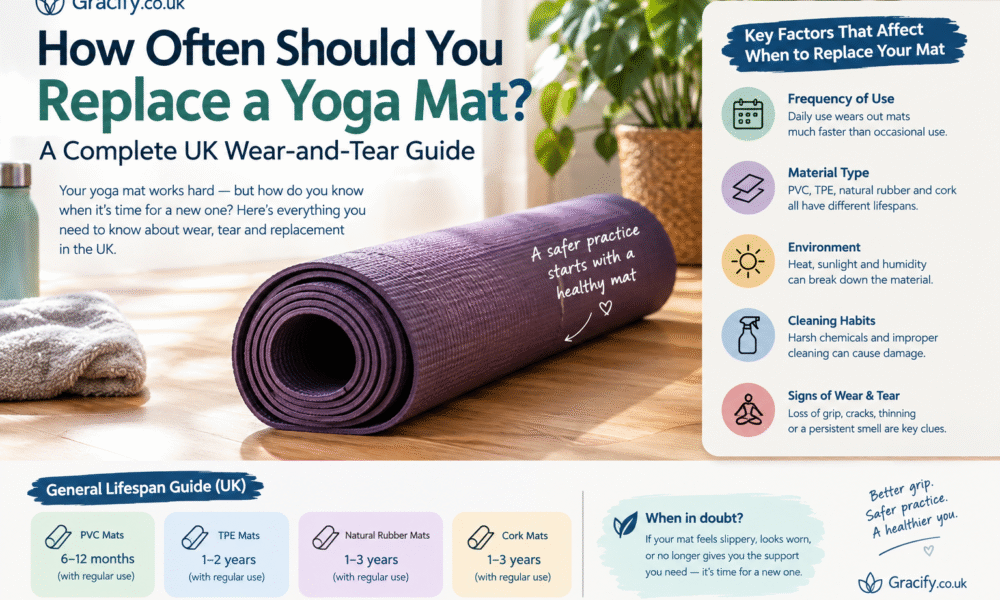
If you’ve ever paused mid-Downward Dog because your hands suddenly slid a few centimetres across the mat, you’ll know the question isn’t really “how often should I replace my yoga mat” in the abstract — it’s “is this the mat’s fault, or mine?” Somewhere between a mat that’s simply due a wash and a mat that’s quietly become a hazard, there’s a lot of guesswork, and most of the advice floating around online doesn’t help much. It tends to boil down to “replace every six to twelve months,” full stop, regardless of what your mat is made of, how often you actually practise, or whether the smell you’re worried about is even a replacement issue at all.
This guide takes a more useful approach. Rather than one blanket number, you’ll get realistic lifespan ranges broken down by material and practice frequency, a full diagnostic list of what worn-out actually looks and feels like, a clear way to tell “needs a clean” apart from “needs retiring,” and — because it’s rarely covered anywhere — what to actually do with a mat once you’ve decided it’s done, including the more sustainable options available here in the UK.
Why there’s no single honest answer to “how long does a yoga mat last”
A yoga mat isn’t a fixed-lifespan product like a lightbulb. It’s more like a pair of running shoes: how long it lasts depends heavily on what it’s made from, how hard and how often you use it, how you look after it, and even the conditions it lives in between sessions.
Two people who bought the exact same mat on the exact same day could reasonably be looking at very different replacement timelines eighteen months later. One does a gentle 30-minute restorative session twice a week in a cool spare room. The other does hot vinyasa five times a week, rolls the mat up damp straight after class, and leaves it in the boot of the car. The first mat might still have years left in it. The second could be showing real wear signs within six months.
So instead of memorising a single number, it’s more useful to understand the variables that actually move the needle:
- Material — PVC, TPE, natural rubber and cork all age differently and respond differently to sweat, heat and UV light.
- Frequency and intensity — daily hot yoga puts far more mechanical and chemical stress on a mat than two gentle sessions a week.
- Body weight and pressure points — heavier practice styles (arm balances, inversions) concentrate wear in specific zones.
- Aftercare — whether you clean it, dry it properly, and store it away from heat and direct sun.
- Storage conditions — a mat left rolled tightly in a hot car will degrade faster than one hung loosely in a cool cupboard.
None of these variables work in isolation — they compound.
A budget PVC mat used daily in a warm studio and never properly dried is working through several stressors at once, and it shows.
Typical lifespan by material and how often you practise
Think of the table below as a starting range, not a countdown timer.
Use it to calibrate your expectations, then let the actual condition of your mat (covered in the next section) make the final call.
| Material | Occasional use (1–2x/week) | Regular use (3–4x/week) | Daily / intensive use |
|---|---|---|---|
| Budget PVC (entry-level, thin) | 12–18 months | 6–12 months | 3–6 months |
| Higher-density PVC | 2–4 years | 1–2 years | 8–14 months |
| TPE (closed-cell foam) | 12–24 months | 8–14 months | 4–8 months |
| Natural rubber (open-cell) | 2–4 years | 1.5–2.5 years | 8–18 months |
| Natural rubber with cork/microfibre top | 2–5 years | 1.5–3 years | 10–20 months |
| Jute-blend | 12–24 months | 8–14 months | 4–8 months |
A few honest caveats worth keeping in mind:
These are ranges, not guarantees. A well-made higher-density PVC mat that’s kept clean and dry can easily outlast a cheap natural rubber mat that’s soaked in sweat and left rolled up damp. Material sets the ceiling; care and usage decide how close you get to it.
Open-cell rubber and cork mats grip better wet but need more looking after. Their absorbent surface is fantastic for hot yoga traction, but it also means sweat, oils and skin cells work their way in more than they would on a sealed PVC or TPE surface. That’s not a flaw — it’s a trade-off you’re already familiar with if you’ve read about material differences elsewhere on this site — but it does mean these mats reward regular, proper cleaning more than most.
What Affects Lifespan Beyond Material
“Daily / intensive” doesn’t just mean frequency — it means heat and sweat volume too. A daily gentle hatha practice in a cool room is nowhere near as hard on a mat as four hot yoga classes a week. If your practice runs hot, treat your mat as though it’s being used more often than the calendar suggests.
Travel and multi-surface use accelerates wear. A mat that goes to the studio, the park, and a friend’s living room picks up more grit, more folding stress, and more UV exposure than one that stays in a single climate-controlled room.
The full diagnostic list: what “worn out” actually looks like
This is the part most guides gloss over with a generic list of five bullet points. Here’s a fuller picture, grouped by what the sign actually tells you.
Structural wear signs
Thinning or compression in high-pressure zones. Press your palm into the areas where your hands and feet land most — often just below centre, where Downward Dog and lunges concentrate weight. If that patch feels noticeably flatter or springier than the edges of the mat, the cushioning foam has started to break down permanently. Unlike a wrinkle that shakes out, compression doesn’t reverse.
Visible cracking, flaking or peeling. Run a fingernail lightly across the surface. If small pieces of material lift off, or you see a fine dust of mat residue on your hands or the floor afterwards, the surface layer is breaking down at a molecular level — usually from a combination of UV exposure, sweat acidity, and repeated flexing.
Bald or shiny patches. Over time, the textured grip surface in high-friction areas (typically where your palms and the balls of your feet land) wears smooth. It often looks slightly shinier or darker than the surrounding mat. This is different from dirt — a bald patch stays smooth even after a thorough clean.
Rips, tears or edge fraying. Obvious, but worth stating plainly: any tear that’s begun to run, or a corner that’s started separating from the main body of the mat, will only get worse. This is a straightforward retire-it sign, no diagnosis needed.
Permanent curling or edges that won’t lie flat. A little curl after being rolled up is normal and usually settles within a few minutes of unrolling. Edges that stay lifted no matter how long the mat’s been flat, or a mat that won’t sit properly on the floor at all, means the material structure itself has taken a set it can’t recover from.
Performance and grip signs
Loss of grip when dry. Try a simple test: hold a Downward Dog or a plank for 20–30 seconds and pay attention to whether your hands or feet creep. A small amount of settling in the first few seconds is normal. Continuous, gradual sliding throughout the hold is not — it usually means the surface texture has worn smooth.
Loss of grip specifically when sweaty. Some mats grip fine dry but become genuinely dangerous once you’re a few sun salutations in and starting to perspire. If this is new behaviour for a mat that used to handle sweat fine, that’s a wear sign, not a design flaw you missed when buying.
A change in how the mat feels underfoot or under the palm. This one’s harder to put into words, but practitioners who’ve used the same mat for a year or more often describe it as the mat starting to feel “dead” — less responsive, less springy, sometimes almost slightly tacky-but-slippery at once. Trust that instinct; it’s usually catching compression before it’s visible.
Hygiene and sensory signs
Odour that survives a proper clean. This is the single most misunderstood sign, and it deserves its own section below — because odour on its own is very often not a replacement issue.
Discolouration or staining that won’t lift. Sweat, especially from hot yoga, can leave yellowish or darker patches over time, particularly on lighter-coloured mats. If a stain persists after cleaning but the mat still performs fine structurally, this is more of an aesthetic issue than a genuine replacement trigger — though heavy, deep-set staining can sometimes indicate the surface has become more porous than it should be.
A tacky residue that won’t wash off. Different from grip — this is a sticky film, sometimes from certain cleaning products reacting with the mat material, or from natural rubber “blooming” (a process where oils in the rubber rise to the surface as it ages, common and mostly harmless, but worth knowing isn’t dirt).
The consequence you shouldn’t ignore
New or recurring joint discomfort during practice. If your wrists, knees or ankles have started aching in poses that never used to bother you, and nothing else about your practice or body has changed, a compressed or thinned mat is a very plausible cause. Cushioning loss shows up as joint strain before it shows up as anything visible.
Quick-reference wear diagnostic table
| What you notice | Likely cause | Cleaning fixes it? | Replace? |
|---|---|---|---|
| Musty smell after use | Sweat/bacteria buildup | Usually yes | No — clean first |
| Smell persists after proper cleaning + full drying | Odour trapped deep in material | No | Yes |
| Visible flaking or dust on hands | Surface material breaking down | No | Yes |
| Slipping only when dry, mat is new-ish | Needs a “break-in” clean (factory coating) | Often yes | No — clean first |
| Slipping that’s gradually worsened over months | Grip texture worn smooth | No | Yes |
| Flattened, springless feel in hand/foot zones | Permanent compression | No | Yes |
| Surface stains, mat performs fine | Cosmetic staining | Partially | No — cosmetic only |
| Rips, tears, edges lifting permanently | Structural breakdown | No | Yes |
| New joint pain during practice | Cushioning loss | No | Yes |
| Sticky film after natural rubber ages | Oil “blooming” | Yes, gentle wipe | No |
Cleaning vs replacing: how to actually tell the difference
This is the distinction that causes the most confusion, and it’s worth slowing down on. A mat that smells bad is not automatically a mat that needs replacing — but a lot of people replace mats that just needed a proper wash — see our yoga mat cleaning guide and guide to getting rid of yoga mat smell first — while others keep using mats that are genuinely past saving because the smell “isn’t that bad.”
Here’s a simple way to work through it:
Step 1 — Give it a proper clean first, not a wipe-down. A quick spray-and-wipe after class removes surface sweat but doesn’t touch what’s worked into the material over weeks or months. Before deciding a mat is done, give it a thorough clean appropriate to its material (this site’s cleaning guide covers the specifics by material type) and — critically — let it dry completely, fully unrolled, out of direct sun, for at least 24 hours. Most odour complaints are actually drying failures: a mat rolled up while still slightly damp creates the perfect environment for the smell to come straight back within a day or two, which understandably feels like “cleaning didn’t work.”
The Three-Step Cleaning Test
Step 2 — Reassess after it’s bone dry. If the smell is gone, that was a hygiene issue, not a structural one — no replacement needed. If a musty or sour smell is still noticeable once the mat is completely dry, that usually means odour-causing bacteria have worked into the material itself, particularly likely with open-cell natural rubber or cork mats that absorb rather than repel moisture. At that point, no amount of further cleaning is likely to fully resolve it, and it’s a genuine hygiene-based replacement trigger.
Step 3 — Separate hygiene issues from structural issues. Cleaning can fix: surface grime, most odours, light staining, the factory finish that makes some new mats slippery for the first few sessions. Cleaning cannot fix: thinning, compression, flaking, tears, worn-smooth grip texture, or permanent curling. If what you’re looking at is on the second list, no cleaning routine — however thorough — will bring the mat back.
A useful rule of thumb: if you can point to it (a tear, a bald patch, a flat spot you can feel with your palm), it’s a replace issue. If you can only smell it or feel a general “off” sense about the mat, try a proper clean-and-fully-dry cycle before assuming the worst.
Common mistakes people make with mat lifespan
- Judging grip loss on day one after buying. Many new mats — PVC and TPE especially — have a factory finish that’s genuinely more slippery until it’s been cleaned once or twice and used a handful of times.
Don’t mistake this “break-in” period for premature wear.
- Rolling a mat up while still damp. This is probably the single biggest cause of early replacement. Trapped moisture breeds odour-causing bacteria and can encourage mould in humid UK homes, ageing a mat far faster than the material itself would otherwise wear.
- Leaving a mat in a hot car. Heat accelerates material breakdown in PVC and rubber alike, and can cause warping or an unpleasant chemical smell in synthetic mats particularly.
- Assuming a higher price tag means indefinite lifespan. A premium mat lasts longer than a budget one on average, but it isn’t immune to wear — it just has a longer runway.
Daily hot yoga will still wear out an expensive natural rubber mat faster than occasional gentle practice wears out a budget one.
- Ignoring joint discomfort because “it’s probably just me.” It sometimes is just you — but if it coincides with a mat that’s a year or two old and hasn’t been replaced, it’s worth testing on a different mat (a studio mat, a friend’s) before assuming it’s unrelated.
- Throwing a mat away the moment it smells, without trying a full clean-and-dry cycle first. As covered above, this leads to replacing mats that didn’t need replacing — and it’s avoidable.
What to do with your old mat: sustainable disposal in the UK
This is the part almost no competing guide covers properly, and it matters — yoga mats are typically made from materials (PVC, TPE composites, foam-rubber blends) that don’t break down in landfill for a very long time, and PVC in particular isn’t accepted in standard kerbside recycling in the UK.
A worn mat doesn’t have to go straight in the general waste bin, though. Here’s what’s realistically available:
Repurpose it before you retire it fully. A mat that’s no longer safe for a full yoga practice often still has life left for lower-stakes uses: a kneeling pad for gardening, a drawer or shelf liner, padding under a pet bed, a kids’ craft or play mat, or a layer under other exercise equipment to protect flooring. Cutting a worn mat into smaller pieces can also make useful non-slip pads for the bottom of rugs or furniture.
Check for material-specific recycling schemes. Some yoga brands run their own mat take-back or recycling programmes — it’s worth checking whether the brand your mat came from offers one before assuming there’s no option. Cork and natural rubber mats, being more biodegradable than PVC, break down considerably faster if they do end up in general waste, and untreated natural rubber offcuts can sometimes be accepted by specialist rubber recyclers (worth a quick search for one local to you, as coverage varies by area).
Donating and Recycling Options
Donate mats that are worn but still structurally sound. A mat that’s lost some grip or shows light cosmetic wear but has no tears, thinning, or lasting odour issues can still be genuinely useful to someone starting out. Local community centres, charity shops, school PE departments, and beginner-friendly yoga studios sometimes welcome gently-used mat donations — a quick call or email to check is worth it before assuming it’ll be turned away.
Use your local council’s household waste recycling centre for genuinely unusable mats. Most UK councils operate household waste recycling centres (HWRCs, sometimes called tip or recycling centres) that accept mixed rubber and plastic items separately from kerbside collection, even when kerbside recycling won’t take them. It’s worth checking your specific council’s website, as accepted materials vary by area — but this is often a better outcome than general landfill waste for a mat that can’t be repurposed or donated.
Avoid the false economy of replacing more than necessary. The most sustainable mat, in the end, is the one you’re not throwing away prematurely — which loops back to the cleaning-versus-replacing distinction above. Getting genuinely useful life out of a mat before retiring it is itself a meaningful part of reducing the volume of mat waste.
The cost-per-use way to think about replacement
Rather than fixating purely on how many months a mat has lasted, it can help to think in terms of cost per session — it reframes “should I replace this” as a practical question rather than a guilt trip.
Take a mat and divide its price by the realistic number of sessions you’ll get out of it before it hits genuine wear signs (not an idealised number — a realistic one, based on your actual practice frequency and the material ranges above). A modestly priced mat replaced every eight months because you practise daily and it wears fast might cost more per session, over a year, than a pricier mat that lasts two to three years under the same use. Equally, if you only practise once or twice a week, a budget mat replaced every 18 months might be perfectly sensible cost-per-use, and spending more upfront wouldn’t necessarily pay off.
This isn’t about finding one “correct” answer — it’s about weighing your actual usage pattern against a mat’s realistic lifespan for that pattern, rather than comparing sticker prices in isolation.
When you’ve decided it’s time: choosing a replacement
Once you’ve worked through the diagnostic signs and confirmed it’s genuinely a replace situation rather than a cleaning one, choosing a new mat comes down to matching material and thickness to how and where you actually practise — grip needs for hot yoga differ from cushioning priorities for a joint-sensitive restorative practice, and travel habits change what’s practical to carry.
Our budget yoga mat buying guide and guide to finding genuine yoga mat deals in the UK cover material, thickness and price in more depth, so it’s worth a look there once you’re ready to shop rather than duplicating that ground here. For now, the main thing worth carrying forward from this guide is simply: buy for your real practice pattern, not an aspirational one, since that’s what will determine how long the new mat actually lasts you.
Your yoga mat replacement checklist
Work through this before deciding either way:
FAQs
How often should you replace a yoga mat?
There’s no single number that applies to everyone. As a general guide, occasional practitioners (one to two sessions a week) can often get two to four years from a quality mat, while daily or intensive practitioners may need to replace theirs every four to twelve months depending on material. The wear signs in this guide are a more reliable indicator than any calendar date.
What are the clearest signs your yoga mat needs replacing?
Visible flaking or dust on your hands, permanent flattening in high-pressure zones, tears or fraying edges, grip that continuously slides during a held pose, and odour that survives a full clean-and-dry cycle are the clearest structural and hygiene signs. New joint discomfort during practice, with no other obvious cause, is also worth taking seriously.
Can a smelly yoga mat just be cleaned instead of replaced?
Often, yes. Most odour is a hygiene issue caused by trapped sweat and moisture, not permanent material breakdown — and rolling a mat up before it’s fully dry is the most common cause. Clean it thoroughly for your mat’s material, let it dry completely unrolled for at least 24 hours, then reassess. If the smell returns even after that, it’s likely worked into the material and is a genuine replacement trigger.
Does yoga mat material affect how long it lasts?
Yes, significantly. Higher-density PVC and natural rubber mats generally last longer than budget PVC, TPE, or jute-blend mats, though open-cell rubber and cork mats need more regular cleaning since they absorb sweat and oils more readily. Care and usage frequency matter as much as material, but material sets the realistic ceiling.
Does hot yoga wear out a mat faster than other styles?
Generally, yes. The combination of heat, higher sweat volume, and frequent handling accelerates wear on most materials, particularly synthetic ones. If your practice runs hot, it’s worth treating your mat as though it’s being used more often than a simple weekly session count would suggest.
Is it safe to keep practising on a mat that’s lost some grip?
It depends on how much grip has been lost and what you’re practising. A small amount of settling at the start of a pose is normal. Continuous sliding during standing poses, balances, or transitions is a genuine safety concern, particularly for wrists, ankles and knees, and is worth addressing rather than working around.
Can you repair a yoga mat instead of replacing it?
Structural wear — thinning, worn-smooth texture, deep tears — generally can’t be reversed or meaningfully repaired at home. Cosmetic issues like light surface staining or a factory-finish slipperiness in a new mat, on the other hand, usually resolve with proper cleaning rather than needing any repair or replacement at all.
What should I do with my old yoga mat in the UK?
Standard kerbside recycling generally doesn’t accept PVC or mixed foam-rubber mats, so it’s worth checking a few better options first: repurposing it for gardening, pet bedding, or shelf lining; donating it if it’s still structurally sound; checking whether the mat’s brand runs a take-back or recycling scheme; or taking it to your local council’s household waste recycling centre, which often accepts mixed rubber and plastic items that kerbside collection won’t.
How can I make a new yoga mat last as long as possible?
Let it dry fully unrolled after every sweaty session before rolling it back up, clean it regularly rather than only when it smells, avoid leaving it in a hot car or direct sunlight, and store it somewhere cool and dry between uses. None of this makes a mat last forever, but it reliably pushes it toward the upper end of its material’s realistic lifespan range rather than the lower end.
Is a more expensive yoga mat always going to last longer?
On average, yes — premium mats tend to use denser, more durable materials that hold up better over time. But price isn’t a guarantee on its own: a premium mat used daily for hot yoga can wear out faster than a budget mat used occasionally, so it’s worth weighing cost against your realistic usage pattern rather than assuming spend alone determines lifespan.