Knee pain shouldn’t mean giving up on yoga altogether — it usually means adapting which poses you do and how you do them. Here’s what to be careful with, what to modify, and how mat cushioning fits into the picture.
Poses That Commonly Aggravate Knee Pain
Deep kneeling poses (like Hero Pose or deep lunges), anything with a sharply bent front knee past 90 degrees, and twisting poses that load the knee joint while it’s bent are the most common culprits. This doesn’t mean avoiding them forever — it usually means using props to reduce the angle or depth until the joint is stronger and more stable.
Knee-Friendly Modifications Worth Knowing
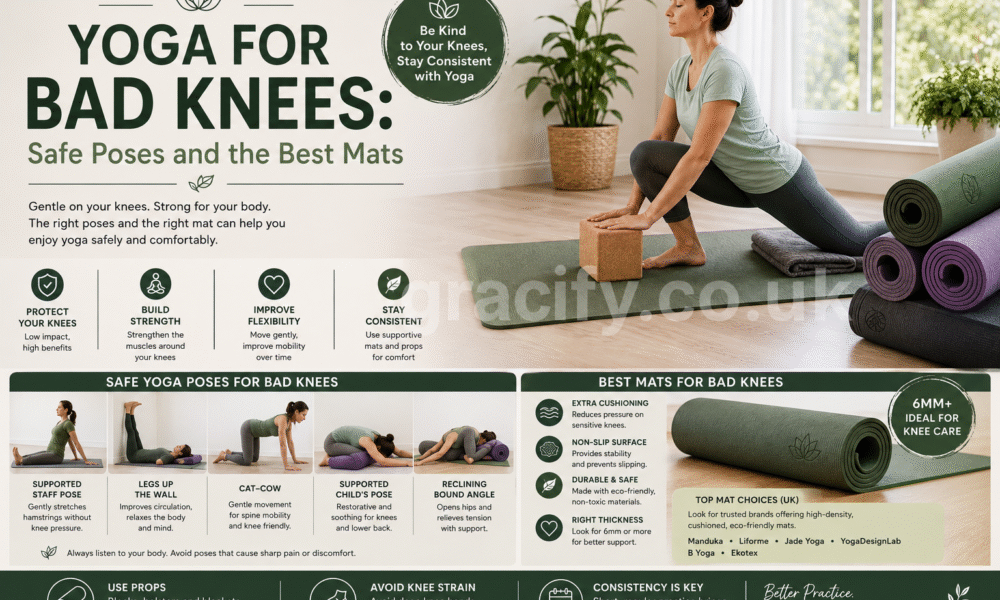
- Kneeling poses: fold a blanket or towel under the knees for cushioning — this alone resolves a lot of discomfort in poses like Cat-Cow or Child’s Pose.
- Lunges: keep the front knee stacked directly above the ankle, never pushed forward past the toes.
- Standing poses: a slight “micro-bend” in the standing leg rather than a fully locked knee reduces joint strain significantly.
- Blocks under the hands in forward folds reduce the need to force extra range through the legs to reach the floor. Our guide to using yoga blocks covers this properly.
Does Mat Thickness Actually Matter for Knee Pain?
Yes, more than people often expect. A thin mat (3mm or less) offers very little cushioning for kneeling poses, which can make otherwise-manageable knee pain considerably worse. Anything from 5mm upward is generally more comfortable for anyone managing joint sensitivity, accepting the trade-off that thicker mats can slightly reduce stability in standing balance poses. Our guide on whether a thick or thin mat is better covers this balance in more depth.
When to See a Professional First
Yoga can genuinely help build strength and stability around the knee joint over time, but it isn’t a substitute for medical advice if pain is new, sudden, sharp, or accompanied by swelling. A physiotherapist can also point you toward which specific poses suit your particular knee issue, since “bad knees” covers a wide range of actual conditions.
A Gentler Starting Point
If standard poses still feel too demanding on the joints even with modifications, chair yoga is a genuinely effective way to build strength and mobility with minimal load through the knees, and it’s a completely reasonable long-term practice, not just a stepping stone. When you’re ready to find a well-cushioned mat suited to your practice, our Yoga Mat Finder tool can help narrow the options down.
Props That Take Load Off the Knees
Most knee-friendly modifications come down to reducing how much the joint bends under load, and props do that more effectively than willpower. A folded blanket or a doubled-over towel under the kneecap turns kneeling poses from sharp to tolerable — place it under the whole knee and the top of the shin, not just the cap, so the joint isn’t perched on an edge.
Blocks are the other essential. Bringing the floor up in lunges and half-splits means the front knee doesn’t have to travel as far, and a block between the thighs in bridge or chair pose encourages the inner thigh and glute engagement that keeps the kneecap tracking properly. A chair used for balance in standing poses lets you build strength without the wobble that makes people lock or twist the joint.
None of this replaces medical advice. Knee pain with swelling, locking, giving way, or pain that persists at rest should be assessed by a GP or physiotherapist before you continue practising — yoga can support rehabilitation but is not a diagnosis.
Frequently Asked Questions
What mat thickness is best for bad knees?
Around 6mm is a sensible balance — enough padding to protect the joint without the instability of a very thick mat. Adding a folded blanket for kneeling poses is often better than buying a thicker mat outright.
Should the knee go past the toes in a lunge?
For most people with knee pain it’s more comfortable to keep the front knee stacked over the ankle, which reduces shear through the joint.
Is yoga safe after a knee replacement?
Often yes, but only with clearance from your surgeon or physiotherapist, and usually with deep kneeling avoided permanently.