Popular choices on Amazon
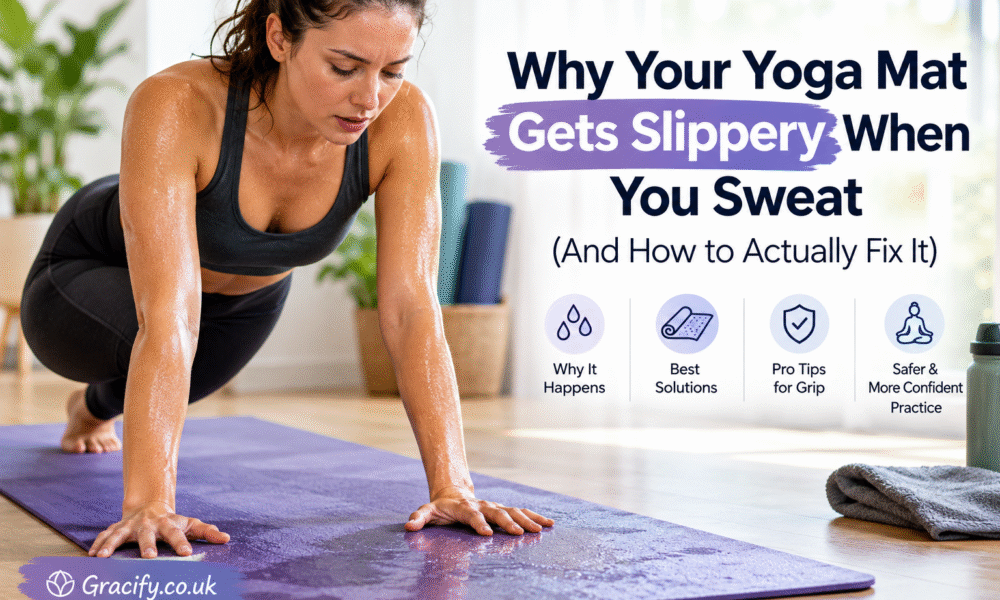
If you’ve ever felt your palms sliding across your mat mid-Chaturanga, or watched your downward dog slowly migrate three inches to the left over the course of a hot class, you already know that sweat and yoga mats have a complicated relationship. It’s one of the most common reasons people give up on hot yoga, Vinyasa flow or any sweaty home practice — not because the poses are too hard, but because the surface underneath them stops being trustworthy.
This isn’t really a mystery, and it isn’t really about buying “the right mat” either — although the mat matters. It’s about understanding what actually happens between your skin and a mat’s surface once moisture gets involved, because that’s the thing almost nobody explains properly. Most advice online jumps straight to a list of ten products without ever answering the question you’re really asking: why does grip fail when I sweat, and what, specifically, stops it?
This guide answers that properly. We’ll cover the physics of wet grip in plain English. We’ll walk through which mat surface types actually hold up in a hot, humid studio versus which just look grippy on a shop shelf. And — just as importantly — we’ll give you a set of practical, non-purchase fixes you can use tonight, whether or not you’re in the market for a new mat. We won’t repeat general buying advice on thickness or eco-materials that’s already covered elsewhere on Gracify; this is specifically about grip, sweat and heat.
Why Sweat Destroys Grip: The Short Version
Grip on a yoga mat comes from friction — the resistance between your skin and the mat surface that stops your hand or foot sliding when weight is loaded through it. Dry skin against a textured or slightly tacky mat generates plenty of friction because the two surfaces interlock at a microscopic level, and there’s nothing between them to reduce that contact.
Sweat changes the equation in two ways at once. First, it adds a thin liquid layer between your skin and the mat, and liquids reduce direct surface contact — this is the same reason a wet road is more slippery than a dry one, or why oil on a worktop makes things slide. Second, once enough sweat pools rather than being absorbed or channelled away, it starts to behave like a lubricant rather than something the mat can “grip through.”
What determines whether a mat copes well with this isn’t marketing language like “non-slip” — it’s what the surface actually does with the moisture once it’s there. Broadly, mat surfaces respond to sweat in one of three ways:
- They repel it. Moisture sits on top as a film, and grip drops sharply the moment sweat appears. This is typical of smooth, closed-cell PVC and cheaper foam mats.
- They absorb it. The surface pulls moisture into itself, keeping the top layer relatively dry to the touch even as you sweat. Closed-cell rubber with a coated top layer, and some polyurethane (PU) surfaces, work this way.
-
Mats That Use Moisture for Grip
They use it. Some surfaces — most notably open-cell natural rubber and untreated cork — actually improve their grip slightly as they dampen, because moisture increases the tackiness of the material itself rather than just sitting on top of it.
That third category is why you’ll sometimes hear “your mat needs sweat to grip properly” — it’s a real phenomenon on the right surface, but it’s also frequently misunderstood and misapplied to mats where it doesn’t apply at all.
The Skin Side of the Equation (The Bit Nobody Talks About)
Most content on this topic treats sweat as a single, uniform problem. It isn’t. How much you sweat, where you sweat from, and what’s in your sweat all change how a given mat will perform for you specifically — which is why two people using the identical mat can have completely different experiences.
Hand sweat is not the same as body sweat. Palms and soles have a much higher density of eccrine sweat glands than most of the rest of the body, and they respond more to stress, heat and exertion than to core temperature alone. This is why some people find their hands are the first thing to slip in a class, even before they’re sweating heavily anywhere else — it’s a distinct physiological response, sometimes called palmar hyperhidrosis when it’s pronounced, rather than simply “sweating a lot.”
Sweat composition varies. Fresh sweat is mostly water with dissolved salts and is close to skin’s natural slightly acidic pH, but as it sits and evaporates, mineral residue becomes more concentrated. On some mat surfaces this residue actually degrades grip over a session — the surface gets a fine, slightly gritty film that reduces the tackiness that was there when the mat was clean. This is separate from long-term mat cleaning (which we cover elsewhere on Gracify) — it’s a within-session effect that changes how your grip feels between the start and end of a single hot class.
Products on Your Skin Affect Grip Too
Lotion, sunscreen and moisturiser matter more than people expect. Any product left on your hands changes the surface tension of your sweat and can make a mat that normally grips well suddenly feel slick. If your hands are more slippery than usual and you haven’t changed mats, check what you put on them before your last shower.
None of this means you’re doing anything wrong — it just means “buy a grippier mat” is only half the answer. The other half is understanding your own hands well enough to work with them.
Heat itself changes the picture too. A studio running at higher temperature and humidity — the classic hot-yoga or Bikram-style setup — doesn’t just make you sweat more, it also changes how quickly that sweat evaporates versus pools. In a normal-temperature room, a light sweat can partially evaporate between poses, giving your mat a brief chance to “reset.” In a genuinely hot, humid room, evaporation slows right down because the surrounding air is already close to saturated, so sweat tends to sit and accumulate rather than lift off. That’s a big part of why a mat that feels perfectly grippy in a cool home practice can feel completely different in a 35°C studio — it isn’t the same challenge at all, and it’s worth choosing your setup with that distinction in mind rather than assuming performance will simply carry across.
Mat Surface Materials, Ranked for Wet Grip
Below is a comparison of the main surface material categories you’ll encounter when mat shopping, specifically rated for how they behave once sweat is involved — not for cushioning, eco-credentials or price, which we cover in our natural rubber vs cork and TPE vs EVA vs PVC material guides.
Mat Materials Ranked for Wet Grip
| Surface type | How it behaves dry | How it behaves wet/sweaty | Typical break-in needed | Best suited to |
|---|---|---|---|---|
| Open-cell natural rubber | Very good, slightly tacky | Excellent — grip often improves as it dampens | Yes, often needs a few sessions or a wash to open up | Hot yoga, heavy sweaters, Vinyasa |
| Closed-cell rubber with textured/coated top | Good | Good to very good, consistent throughout class | Minimal | All-round practice, studio use |
| Cork (natural, untreated) | Good, slightly firm underfoot | Very good — cork’s texture increases grip as moisture is absorbed | Minimal, though a light surface “seasoning” helps | Warm, sweaty practice; those who dislike rubber smell |
| Polyurethane (PU) top layer | Excellent | Excellent, often the best “straight out of the box” grip | None — performs from first use | Hot yoga, competitive/advanced practitioners |
| Suede/microfibre-topped mats | Good dry, absorbs sweat | Very good — acts like a built-in towel, but can feel slippery once saturated | None | Shorter hot sessions, those who dislike rubber feel |
| TPE (thermoplastic elastomer) | Fair to good | Fair — moderate drop-off as sweat increases | None | Light/moderate sweaters, gentle yoga, budget buyers |
| Standard PVC/foam | Fair dry | Poor — grip drops sharply once damp | None | Occasional, low-sweat practice only |
| Jute-blend surfaces | Fair, textured | Fair to poor — natural fibres can feel rough when wet and lose bite | Minimal | Low-sweat, eco-focused buyers |
What the Table Means in Practice
A few things worth pulling out of that table. PU-topped mats tend to be the standout choice specifically for hot yoga because, unlike open-cell rubber, they don’t need several sessions of “breaking in” before the grip fully kicks in — but they typically cost more and some practitioners dislike the very slightly rubbery smell PU can have when new. Open-cell rubber is the classic hot yoga recommendation for good reason, but it’s genuinely the case that a brand-new open-cell rubber mat can feel less grippy in your first session or two than it will after it’s been used and washed a handful of times — more on that below.
The Overlooked Fix: A Towel Isn’t a Compromise, It’s a Different Tool
A huge amount of online advice frames a yoga towel as the budget fallback for people who can’t afford a “proper” grippy mat. That’s the wrong way to think about it. A good hot-yoga towel and a good hot-yoga mat solve the sweat problem through completely different mechanisms, and understanding the difference helps you pick the right tool — or combination — for your situation.
A mat surface (rubber, cork, PU) is designed to grip despite moisture, using the material properties described above. A yoga towel, by contrast, is designed to actively remove moisture from the equation by absorbing sweat as you go, so your skin contact stays closer to dry throughout the class. Many towels marketed for hot yoga also have a raised, gripping surface texture on the underside (silicone dots or a corrugated grip backing) that anchors them to the mat below, and a texture on the top designed to bite even when damp. If you’re practising on a hard floor rather than a studio surface, our guide to yoga mats for hardwood floors covers the same grip problem from the floor side.
Towel vs Mat: How They Compare
| Grippy mat alone (rubber/cork/PU) | Yoga towel over a mat | |
|---|---|---|
| How grip is achieved | Material chemistry interacting with moisture | Active absorption keeps surface drier |
| Performance in very heavy sweat | Can still saturate and slip late in class | Stays more consistent, but towel itself will eventually saturate |
| Feel underfoot/underhand | Closer to bare mat texture, more “sticky” feel | Softer, more fabric-like feel; some find it less stable until damp “activates” grip |
| Portability | Mat is the whole kit | Adds packing weight, but a towel packs down small if you’re travelling with your own mat |
| Cost to try | Requires buying a new mat | Cheap way to test whether moisture management, not surface material, was your real issue |
| Washing | Mat wiped/washed occasionally | Towel needs washing after every sweaty session |
| Downside | Fixed once bought | Needs correct placement each time; can bunch or shift if it isn’t the right size for your mat |
The most useful thing to take from this table: if you’re not sure whether your issue is your mat or your sweat level, a towel is the cheapest possible experiment. If a towel over your existing mat solves the problem, you’ve saved yourself the cost of a new mat entirely. If it doesn’t fully solve it, you’ve learned that your base mat surface is the actual bottleneck, and a rubber, cork or PU mat is a better investment than another towel.
Practical Fixes That Have Nothing to Do With Buying a New Mat
Before you spend money, there are several things worth trying, and most of them make a bigger difference than people expect — our step-by-step guide to fixing a slippery yoga mat walks through the fixes in more detail.
Break in a new rubber or cork mat properly. Open-cell natural rubber and cork mats are often at their least grippy when brand new, because a very thin manufacturing residue sits on the surface and the material hasn’t yet been “opened up” through use. Two things help: wiping the mat down with a damp cloth and mild solution before first use to remove that residue, and simply using the mat for several sessions — grip on these materials tends to improve noticeably by the third or fourth wash-and-use cycle. Some practitioners speed this along with what’s sometimes called the “salt trick” — lightly rubbing coarse salt across the surface with a damp cloth, then rinsing thoroughly, to help open the material’s texture faster. If you try this, test on a small area first and rinse the mat completely, since leftover salt residue can attract more moisture than you want.
In-Class Habits That Help
Wipe your mat mid-class, not just after. A quick pass with a small microfibre cloth between sequences — especially before a heavy hand-loading sequence like sun salutations — removes the surface film of sweat before it becomes a slip hazard, without waiting for a full post-class clean.
Use hand chalk designed for sport, sparingly. Liquid or powdered chalk (the same category used in climbing and gymnastics) works by absorbing surface moisture rather than covering it up, and a small amount on your palms before a sweaty sequence can restore grip fast. It’s not universally loved in yoga spaces — some studios discourage powdered chalk because of mess on shared mats and studio floors, and liquid chalk is generally the more practice-friendly option for this reason. Use a light layer; too much creates its own slightly gritty, sweat-repelling film, which defeats the purpose.
Technique and Environment Fixes
Rethink hand and foot positioning under load. A lot of “slipping” in poses like plank, Chaturanga and downward dog isn’t purely a grip problem — it’s a weight-distribution problem that grip is being asked to compensate for. Spreading your fingers fully and pressing evenly through the base of each finger and the heel of the hand (rather than concentrating weight in the palm’s centre) increases your effective contact area and reduces the load any single point of contact has to resist. The same applies to feet: pressing evenly through all four corners rather than letting weight roll to the inner edge reduces the sideways sliding force a slick mat has to fight against.
Manage your practice environment, not just your mat. In a home hot-yoga setup, a fan angled to keep air moving across the room (without blasting directly on your mat) reduces how much sweat pools versus evaporates. In a studio, arriving a few minutes early to claim a spot away from the most heavily used studio floor mats — which can carry residual moisture and product build-up from previous classes — genuinely helps.
Consider a grip spray, cautiously. Grip-enhancing sprays exist for both mats and hands, generally using a mild tackifying or moisture-absorbing formula. They can help in the short term, but they’re a maintenance product, not a fix for a fundamentally unsuitable mat surface — and overuse on some closed-cell surfaces can leave a residue that attracts more grime over time. Treat sprays as a top-up, not a substitute for the underlying material doing its job.
Common Mistakes That Make Sweaty-Hand Slipping Worse
- Using more lotion or moisturiser on practice days. It feels counterintuitive to skip it, but any product on your palms reduces the friction your skin can generate, on top of whatever sweat is already there.
- Buying a “grippy” mat based on texture alone, tested dry, in a shop. A mat can feel wonderfully tacky to a dry touch and still perform poorly once genuinely damp — dry-hand testing in a shop tells you very little about hot-yoga performance.
- Washing a rubber or cork mat with strong detergents or oil-based cleaners. These can leave a film that actively reduces the material’s natural grip, undoing the very break-in process described above. A mild solution and thorough rinse is enough.
- Rolling a damp mat up tightly and leaving it in a bag for days. Beyond hygiene issues, trapped moisture against a mat surface can affect its texture and grip characteristics over time, especially with fabric-topped or suede mats.
- Assuming a thicker mat will grip better. Thickness affects cushioning and joint comfort, not surface friction — a thick mat with a poor surface material will still slip in a hot class. Don’t conflate the two properties when shopping.
- Ignoring your own sweat pattern. If your hands sweat noticeably more than your feet (or vice versa), a one-size solution like “just get a grippier mat” may not address your actual weak point — a towel positioned specifically where your hands land, or targeted chalk use, may serve you better than a whole-mat overhaul.
- Practising barefoot on a freshly mopped or polished studio floor extension beyond the mat edge. Grip fails happen off the mat too, particularly in transitions — be aware of where your mat ends.
A Pre-Practice Grip Checklist
Run through this before a hot or heavy-sweat session, especially if slipping has been an issue recently:
- Mat wiped down and fully dry before you start (residual damp from last use reduces starting grip)
- Hands and feet free of lotion, sunscreen or oil-based product
- Small towel or cloth within reach for a mid-class wipe-down
- Hand chalk (liquid, if your studio prefers it) packed if you tend to sweat heavily through the hands specifically
- Mat surface checked for wear — a rubber or PU mat with visibly smoothed, shiny patches in high-use zones (typically where hands land) has lost surface texture and will grip worse regardless of what you do
- If using a towel, confirm it’s the correct size for your mat and lies flat with no bunching before you begin
- Room airflow considered — a fan positioned to circulate air, not blow directly onto the practice surface
- A realistic plan for what you’ll do if you do start slipping mid-class (pause, wipe, reset stance) rather than pushing through and risking a fall
How to Match a Fix to Your Actual Problem
Not everyone’s sweaty-hands issue is the same, so it helps to diagnose before you spend money.
If you sweat heavily everywhere, fast, from the start of class: an open-cell natural rubber or PU-topped mat is likely to serve you best long-term, since these are specifically suited to sustained heavy moisture rather than just resisting an initial damp patch.
When it’s specifically your hands, and your feet are generally fine: targeted solutions — chalk, a hand-sized grip cloth, or attention to hand positioning — may solve the problem without changing your whole mat setup.
If grip is fine at the start of class but degrades badly by the end: this points to moisture accumulation rather than a fundamentally unsuitable surface, and a towel or mid-class wipe-down routine is likely to help more than a new mat.
More Scenarios
Travelling between a home mat and studio-provided mats: a lightweight, packable towel with its own grip backing gives you consistent grip regardless of what surface you’re handed, which a mat purchase alone can’t solve.
For a diagnosed condition affecting sweat, such as hyperhidrosis: the fixes above (chalk, absorbent towels, positioning) are still relevant, but it’s worth discussing persistent excessive sweating with a GP or dermatologist if it’s affecting daily life beyond yoga — a mat is never going to fully solve a medical-level sweating pattern on its own.
If you practise mainly at home rather than in a studio: you have more control over the environment than a studio-goer does. That means the “manage the room, not just the mat” fixes are worth prioritising: airflow, room temperature, even the time of day you practise. A session straight after work in a warm room will differ hugely from an early-morning one in a cooler room. Two people with identical mats can have very different experiences purely because of the room they’re practising in.
Deciding between spending money on a new mat versus accessories: as a rough rule, accessories (a towel, chalk, a cleaning routine adjustment) are the lower-risk, lower-cost experiment, and they remain useful even after you eventually upgrade your mat. A new mat is the right call once you’ve confirmed, through those cheaper tests, that the base surface itself — not moisture management — is the limiting factor.
Frequently Asked Questions
Why does my yoga mat get slippery only when I sweat, not when it’s dry?
Because grip depends on direct skin-to-surface contact, and sweat introduces a thin liquid layer that reduces that contact. Some mat surfaces (open-cell rubber, cork) counteract this by becoming tackier as they absorb moisture; others (PVC, standard foam) simply lose grip as the liquid layer builds up with nothing to interrupt it.
Is a towel better than a grippy mat for hot yoga?
They solve the problem differently rather than one being strictly better. A grippy mat surface works through moisture-friendly material chemistry; a towel works by actively absorbing sweat to keep the surface drier. Many heavy sweaters find the two work best together — a good towel over a mat with a decent base grip — rather than relying on either alone.
Why does my new rubber or cork mat feel less grippy than I expected?
This is common and usually temporary. Both materials often carry a light manufacturing residue when new, and their surface texture typically “opens up” with use and washing. Grip on these materials tends to improve noticeably over the first several sessions rather than being at its best straight out of the packaging.
Does mat thickness affect grip?
Not directly. Thickness affects cushioning and how much you feel the floor through the mat — grip is determined by the surface material and texture, not how thick the mat is underneath that surface. A thin mat with a good grip surface will out-perform a thick one with a poor surface every time sweat is involved.
Is hand chalk okay to use for yoga, or is that just for climbing and gymnastics?
It’s increasingly used in yoga, particularly by heavy sweaters in hot classes, and works on the same principle — absorbing surface moisture from the skin. Liquid chalk tends to be more practice- and studio-friendly than powdered chalk, which can leave residue on shared surfaces. Use sparingly, since too much can create its own slightly gritty, grip-reducing film.
Can washing my mat with the wrong products make grip worse?
Yes. Strong detergents, oil-based cleaners or anything that leaves a residual film can coat the surface and reduce the natural tackiness of rubber and cork mats in particular. A mild solution with a thorough rinse and full air-dry before rolling protects the grip properties you’re trying to preserve. (For a full mat-cleaning routine, see our dedicated cleaning guide.)
Why do my hands sweat so much more than the rest of my body during yoga?
Palms and soles carry a much higher density of sweat glands than most skin, and they respond strongly to exertion, heat and even nervous tension, somewhat independently of your overall body temperature. This is a normal physiological pattern, not a sign anything is wrong, though it does mean hand-specific grip solutions (chalk, hand positioning, a smaller grip towel) are often more useful than whole-mat changes for people whose sweating is concentrated there.
Does lotion or sunscreen actually make that much difference to grip?
Yes, more than most people expect. Any product on the skin changes surface friction and how sweat behaves once it appears, and can turn a mat that normally performs well into one that feels unexpectedly slick. If grip suddenly feels worse than usual with no change to your mat or effort level, what’s on your hands is worth checking before anything else.
What’s the single best material for hot yoga specifically, if I could only pick one?
Polyurethane (PU) top-layer mats and open-cell natural rubber mats are generally the two strongest options purely for sweat performance, with PU having the advantage of performing well from first use, and rubber having the advantage of continuing to improve with wear. Cork is a strong third option, particularly for people who dislike the smell or feel of rubber.
Is it normal for grip to feel different at the start versus the end of a hot class?
Yes, to some degree, on almost every surface — moisture builds up over the session even on well-designed mats. A noticeable, sudden drop-off partway through is more often a sign of surface saturation than a faulty mat, and is exactly the scenario a mid-class wipe-down or a towel is designed to address.
Building a Setup That Actually Works for You
There’s no single “best yoga mat for sweaty hands” that suits everyone, because the problem isn’t uniform — it depends on how much you sweat, where from, what kind of heat and duration you’re practising in, and what you’re already doing (or not doing) to manage moisture before it becomes an issue. What does hold true across the board is that grip is a system, not a single product: the mat surface, whether you’re using a towel, how you’re positioning your hands and feet under load, and small habits like wiping down mid-class all combine to determine whether you feel stable or unstable in a sweaty session.
Start with the cheapest, lowest-commitment fixes — checking what’s on your hands, trying a towel over your existing mat, adjusting hand positioning — before assuming you need to replace your mat entirely. If you’ve ruled those out and grip is still failing, that’s the point at which a surface built specifically for moisture, like open-cell rubber, cork or a PU top layer, earns its place in your kit. Either way, understanding why grip fails puts you in a much stronger position than working through a list of products hoping one happens to fix it.