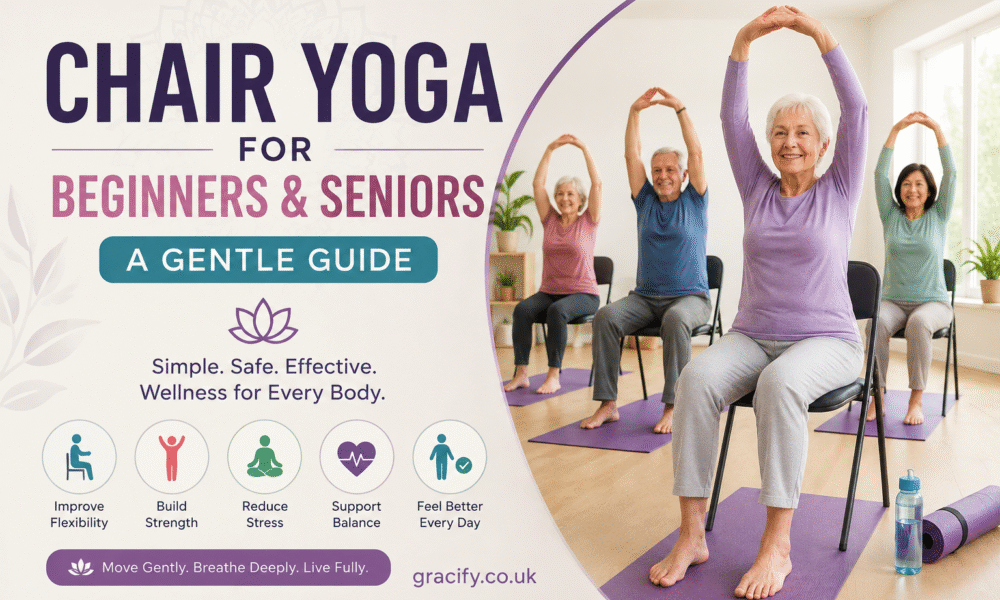
Chair yoga strips away the two biggest barriers to starting a practice — getting down onto the floor, and worrying about balance. It’s genuinely effective, not just a watered-down version of “real” yoga, and it works well for seniors, beginners, anyone recovering from injury, or simply anyone who wants a gentler entry point.
Who Chair Yoga Genuinely Suits
Chair yoga is often framed purely as a seniors’ practice, but that undersells it. It’s equally useful for office workers wanting movement between meetings, anyone with limited mobility or balance concerns, people recovering from injury or surgery, and complete beginners intimidated by a full floor-based class. The core benefits — improved flexibility, gentle strength building, better circulation and stress reduction — apply just as much seated as on a mat.
A Simple Seated Sequence to Start With
- Seated breathing (1–2 minutes): sit tall, feet flat on the floor, and take slow, deep breaths to settle in.
- Seated Cat-Cow (2 minutes): hands on knees, alternate arching and rounding the spine with your breath — the seated version of one of yoga’s most useful warm-ups.
- Seated twist, both sides (2 minutes): one hand on the opposite knee, gently rotate the spine, holding the back of the chair for support if needed.
- Seated forward fold (2 minutes): hinge forward from the hips over the legs, letting arms hang, to gently stretch the lower back and hamstrings.
- Ankle and wrist circles (2 minutes): simple joint mobility work, genuinely useful for circulation and often overlooked.
Do You Need Any Equipment?
Just a sturdy, armless chair that won’t slide on the floor. A mat isn’t strictly necessary for chair yoga, though placing one under the chair can stop it slipping on hard floors — our Yoga Mat Finder tool can help if you decide a mat would be useful alongside your chair practice.
Building Confidence Toward a Standing Practice
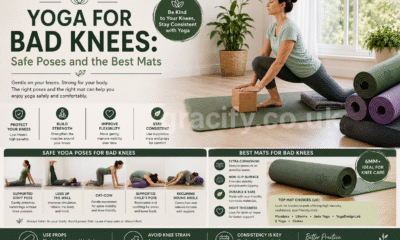
Chair yoga is a complete practice in its own right, not just a stepping stone — plenty of people do it exclusively and get real, lasting benefit. That said, if and when standing or floor-based poses start to feel appealing, our complete beginner’s guide to home yoga is a natural next step, and if joint discomfort specifically (rather than balance or mobility generally) is the main concern, our guide to yoga for bad knees covers safe modifications in more depth.
How Often and How Long to Practise
Chair yoga rewards frequency over duration. Ten to fifteen minutes most days does more for joint mobility and circulation than a single long weekly session, particularly for anyone who spends much of the day seated. Two shorter sessions — a few minutes of shoulder and neck work in the morning, some seated twists and ankle circles later — is a pattern many people find easier to sustain than one block of time.
Progress looks different here than in a standing practice. The markers worth watching are practical ones: standing up from the chair without using your hands, reaching a high shelf comfortably, turning far enough to check a blind spot when driving. If a movement causes sharp pain, dizziness or breathlessness, stop. Anyone with a recent fall, uncontrolled blood pressure, a new joint replacement or heart condition should check with their GP before starting, and a sturdy chair without wheels is non-negotiable.
Frequently Asked Questions
Is chair yoga real yoga?
Yes — it uses the same poses, breathing and attention, simply supported by a chair. The benefits to mobility, balance and stress are well documented.
What kind of chair should I use?
A stable, armless dining chair with four legs and no wheels, placed on a non-slip surface with your feet flat on the floor.
Can chair yoga help with balance?
It can, particularly the standing-with-chair-support variations, which build the leg strength and ankle stability that underpin balance.