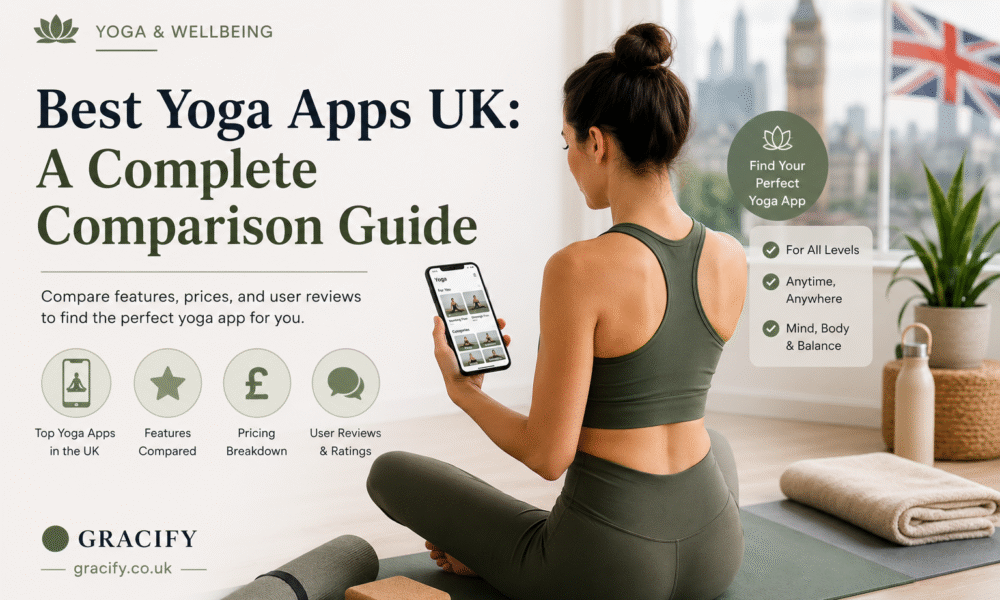
Studio memberships in the UK typically run £80-150 a month for unlimited classes, which is a serious commitment for something you might only manage to attend twice a week around work and family life. Yoga apps have become the practical alternative for a huge number of practitioners — cheaper, available at 6am or 11pm, and increasingly sophisticated in how they structure a practice. But “yoga app” covers a wide range of approaches, from short guided sessions to full studio-style class libraries to AI-adjusted programmes, and picking the wrong one for your goals is a common reason people give up on a home practice within a few weeks. This guide compares the main approaches, what each is actually good for, and how to choose sensibly rather than just downloading whatever ranks first in the app store.
What Actually Differs Between Yoga Apps
Beyond surface-level differences in interface and price, yoga apps genuinely differ on a handful of things that matter for whether you’ll actually stick with one: teaching style (alignment-focused and slow versus flow-based and fast-paced), structure (a single library of standalone classes you pick each day versus a defined multi-week programme with progression built in), specialisation (general yoga versus a specific focus like prenatal, back pain, or athletic mobility), and pricing model (a flat monthly subscription versus a one-off programme purchase versus a free app monetised through ads or premium upsells). None of these is objectively “better” — the right choice depends entirely on what kind of person you are about sticking with a routine and what you’re actually trying to get out of the practice.
Structured-Programme Apps vs Class-Library Apps
A structured-programme app gives you a defined path — day 1, day 2, day 3 — building progressively toward a specific outcome over a set number of weeks. This suits people who find endless choice paralysing, since there’s no daily decision about what to practice; you simply do the next thing in the sequence. The trade-off is less flexibility if your body needs something different on a particular day (more restorative after a bad night’s sleep, for instance).
A class-library app instead offers a large searchable catalogue — by duration, style, teacher, body focus, or energy level — that you browse and choose from each time you practice. This suits people who already have some yoga experience and want the freedom to match a session to how they’re actually feeling that day, but it demands more self-direction, and it’s easy to default to the same three favourite classes indefinitely rather than getting well-rounded practice across different styles and body areas.
Many popular apps now blend both models — offering curated programmes for people who want structure alongside a full searchable library for people who don’t — which is generally the most flexible approach if you’re not sure which type suits you yet.
Teaching Style: What to Actually Look For
The single biggest factor in whether an app’s classes feel right for you is teaching style, and this varies enormously even within apps that are nominally “for beginners.” Some teachers give detailed, continuous verbal cues about alignment and breath, which is genuinely valuable for beginners learning correct form but can feel overly talkative for more experienced practitioners who want to move with less narration. Others teach with minimal cueing and more visual demonstration, which suits confident practitioners but can leave true beginners unsure whether they’re doing a pose correctly.
Pace also varies hugely — some apps default to a brisk, cardio-adjacent flow style, while others favour a slower, more meditative pace even in their “beginner” content. Most apps offer free trial periods specifically because teaching-style fit is so personal; it’s worth genuinely testing two or three different teachers within an app (or across two different apps) before committing to a subscription, rather than judging a whole platform on your first single class.
Specialised Apps for Specific Goals
If you have a specific reason for practising — pregnancy, a bad back, marathon training recovery, or managing stress and anxiety — a specialised app or programme, rather than a general yoga library, often delivers better results faster, since the content is designed by people with specific expertise in that area rather than being a generic sequence loosely labelled for the purpose. Prenatal-specific programmes account for trimester-appropriate modifications throughout, rather than a single “pregnancy modifications” disclaimer bolted onto generic classes. Back-pain-focused programmes are typically built by instructors with a physiotherapy or rehabilitation background and sequence progressively rather than offering an unstructured pick-and-mix of poses. Athletic-recovery-focused content (often labelled “yoga for runners” or “yoga for athletes”) tends to prioritise the specific tight areas repetitive sport creates — hips, hamstrings, calves, shoulders — over a more general full-body sequence.
Free vs Paid: What You Actually Get for Your Money
Free yoga content, whether through ad-supported apps or free video platforms, has improved enormously in quality over the past several years and is a genuinely reasonable starting point, particularly for absolute beginners who aren’t yet sure whether a home practice will suit them. The trade-offs tend to be: less structured progression (a scattered library of individual videos rather than a designed programme), more inconsistent teaching quality since content isn’t curated to the same standard, and, for ad-supported apps, interruptions that can break the flow of a session in a way that genuinely affects the experience.
Paid subscriptions, typically running £8-20 a month for UK-focused platforms, generally buy you: professionally structured programmes with genuine progression, more consistent production and teaching quality, offline downloads for practising without a data connection, and increasingly, some form of personalisation — recommended classes based on what you’ve done before, or programmes that adjust based on stated goals and available time. For someone who has already tried a free app and knows they’ll stick with a home practice, the jump to paid is often genuinely worth it for the structure alone, since lack of structure is one of the most common reasons people’s home practice fades out after a few weeks.
What Google’s Standards Mean for the Content You’ll Find
Since yoga app content varies so much in who actually makes it, it’s worth applying a similar standard to what you’d want from any health-adjacent information: content led by qualified, identifiable instructors (rather than anonymous or AI-generated sequences) tends to be more reliable, particularly for anything touching on injury, pregnancy, or a medical condition. Apps that are transparent about instructor qualifications, that clearly separate general wellness content from anything making specific health claims, and that include sensible safety disclaimers for beginners are generally a safer long-term choice — the same principles that make written health content trustworthy apply just as much to video-based instruction.
Building a Sustainable Home Practice Around an App
Regardless of which app you choose, a handful of habits determine whether it becomes a lasting practice rather than a forgotten subscription. Fixing a consistent time — even just 15-20 minutes, most mornings or most evenings — matters more than session length, since habit formation depends far more on consistency than on any single session’s intensity. Starting with shorter, more frequent sessions (15-20 minutes, four to five times a week) tends to build a sustainable habit better than committing to hour-long classes that quickly feel like too large a commitment on a busy day.
Using the app’s progress-tracking or streak features, where available, provides a small but genuinely effective nudge toward consistency for most people. And treating the first few weeks as an experiment rather than a permanent commitment — trying a couple of different teachers or styles within the app before settling into a routine — avoids the common mistake of judging a whole platform, or home yoga generally, based on a single class that didn’t click.
Equipment Worth Having for App-Based Practice
A proper yoga mat with reasonable grip matters more for home practice than it might in a studio, where a shared or rental mat is at least a known quantity — a cheap, overly thin, or worn mat is one of the most common reasons people find home practice uncomfortable enough to quit. Beyond the mat, a block or two and a strap cost very little and expand which poses and modifications are actually accessible, particularly for anyone starting with limited flexibility. A phone or tablet stand at eye level, rather than propping a device against a wall, makes it much easier to actually see cues and demonstrations clearly during standing and balance poses, where glancing down at a low screen disrupts alignment.
Pricing Snapshot for the UK Market
While exact pricing changes over time and by promotion, it’s useful to know the rough tiers you’ll encounter when comparing UK-available yoga apps. Free, ad-supported apps sit at the bottom, typically offering a genuinely usable library of dozens to hundreds of classes with the trade-off of ads between sessions and less curated progression. Budget subscriptions, often around £5-10 a month or £40-70 annually, usually come from apps focused specifically on yoga (rather than broader fitness platforms), with a smaller but more curated and progression-focused library.
Mid-tier subscriptions, roughly £10-20 a month or £70-150 annually, are common among the larger, more established platforms and typically include multiple instructors, specialised programmes (prenatal, back care, athletic recovery), offline downloads, and some form of personalisation. At the top end, some platforms bundle yoga into a broader wellness subscription alongside meditation, fitness, and sleep content, often running £15-25 a month — worth considering if you want one subscription covering more than yoga alone, but not worth paying for if yoga is genuinely all you’ll use.
Annual plans typically offer a meaningful discount over paying monthly — often 30-40% cheaper per month when paid yearly — but are only good value if you’re reasonably confident you’ll stick with the app past the first couple of months, which is exactly why most platforms offer a free trial or a cheap first-month rate specifically to let you test fit before committing to a full year.
Red Flags Worth Watching For
A handful of warning signs are worth checking for before subscribing to any yoga app, especially one you haven’t used before. Vague or entirely absent instructor credentials, as mentioned above, is one of the clearest signals that content quality may be inconsistent. Auto-renewing annual subscriptions with no clear, easy cancellation path inside the app itself (requiring an email or phone call to cancel, for instance) are worth being cautious of, since this is a common pattern used to make cancelling deliberately inconvenient.
Apps making specific medical claims — promising to “cure” a health condition rather than support general wellbeing — should be treated with real scepticism regardless of how professional the marketing looks, since legitimate yoga instruction, however good, isn’t a substitute for medical treatment and shouldn’t claim to be. And a complete absence of beginner-specific content or modifications, with everything pitched at an assumed intermediate level, is a sign the app may not suit you if you’re just starting out, however well-produced the content otherwise looks.
How to Trial an App Properly Before Committing
Rather than judging an app after a single class, a more reliable approach is to use the free trial period (most reputable apps offer one, typically 7-14 days) to sample at least three to five different classes across different teachers, durations, and styles within the platform. Pay attention not just to whether you enjoyed a session but to more practical signals: did the cueing pace match your ability to follow along, could you clearly see demonstrations on your screen size, did the class length fit realistically into your actual daily routine rather than an idealised version of it, and — importantly — did you actually want to do another session the next day, or did it feel like a chore. That last signal is often the most reliable predictor of whether a subscription will get real, sustained use rather than becoming a forgotten monthly charge.
It’s also worth testing the app on the device and in the space you’ll realistically use it — if you plan to practice in a small room with your phone propped against a wall, test exactly that setup during the trial rather than assuming a class that looked great on a laptop screen will translate to a cramped view on a phone. Small practical frictions like these are disproportionately responsible for good intentions not turning into an actual habit.
Should I switch apps if I’m not seeing progress?
Before switching, it’s worth checking whether the issue is the app or the consistency of use — most yoga progress, whether flexibility, strength, or stress reduction, depends on regular practice over a period of months rather than any particular platform’s programming. If you have been consistent for at least six to eight weeks and still aren’t noticing any change in how your body feels, or if sessions consistently feel mismatched to your level despite trying different classes within the app, that’s a reasonable point to try a different platform or teaching style rather than assuming more time on the same app will fix it.
Do I need different apps for different goals, or can one app cover everything?
Many of the larger platforms now cover general practice, specialised programmes, and even adjacent areas like meditation or basic strength work within a single subscription, so one well-chosen app can genuinely cover most people’s needs without paying for multiple overlapping subscriptions. The exception is a genuinely specific, ongoing need — serious pregnancy-specific instruction or structured rehab for a significant injury, for example — where a dedicated specialist app or, better, guidance from a qualified professional in that area, tends to serve you better than a general platform’s broader specialised content.
Frequently Asked Questions
Can a yoga app really replace in-person classes?
For general fitness, flexibility, and stress-relief goals, a good app genuinely can replace regular studio attendance for most people, particularly once you have a basic grasp of correct form. What apps can’t replace is hands-on adjustment and real-time correction from a teacher watching your specific body, which matters most for beginners still learning alignment and for anyone working through a specific injury — a mixed approach (occasional in-person classes or a single session with a qualified teacher, supplemented by app-based practice) captures most of the benefit of both.
How do I know if an app’s teachers are properly qualified?
Reputable apps list instructor bios including their certifying body and hours of training (200-hour and 500-hour Yoga Alliance certification are the most recognised international standards) — if an app doesn’t disclose this information anywhere, that’s a reasonable reason for some caution, particularly if you’re using it for anything beyond very general, gentle practice.
Is it safe to follow a yoga app if I have an existing injury or health condition?
General apps aren’t a substitute for guidance specific to your situation — if you have a diagnosed injury, are pregnant, or manage a chronic health condition, it’s worth getting clearance and, ideally, some specific modifications from a doctor, physiotherapist, or qualified yoga teacher before relying on generic app content, since even well-made general classes aren’t designed around your individual circumstances.